January Astrophotography 2023

Hi everyone, I hope we are all doing well! Life for me has been busy since I last posted. Mainly through teaching mathematics at Cornwall College, I haven’t been able to update my blog as often as I would have liked. I have been keeping up to date with my social media, so if you are interested in my astrophotography from last year, please take a look by clicking the social media symbols at the bottom of the page.

For now, I will start a new blog for 2023, starting with January astrophotography!

Beer Beach - Devon

My only shoot of January was a visit to Beer Beach and Pounds Pool Beach on the south Devon coast. This shoot was a year in the planning as the tides and conditions had to be just right.

Cliffs between Beer and Pound Beach.

Being a big low tide allowed me to explore the impressive cliffs. Lots of photo opportunities with Orion positioned nicely to the southwest.

Cave at Pound Pools Beach.

One of the things that drew me to Pound Pools Beach is the dramatic caves on the beach's north side. This was one of my favourite images from the night. I love how a cave can frame a scene!

Pounds Pool Beach.

I was also impressed with how dramatic the foreshore was and got down low to this interesting rock for a foreground to compliment the sky and overall scene.

Pounds Pool Beach.

My final image of this night was this scene where I included a foreground cliff to add some balance and depth. A fantastic night on the south Devon coast to sign of January.

June Astrophotography 2021

May was a lacklustre month for astrophotography for me, so I was eager to make up for that with plenty of Astro trips through June. The first of which was a trip to the north coast of Cornwall to explore the coast around Duckpool. The first feature that grabbed my attention where these wonderful satellite dishes.

I then hiked to the water’s edge and found this small stream curving through the peddles to the ocean. The Milkyway was in a nice position, this late in the night, and provided a nice background element top with this peaceful scene.

Duckpool.

Later in the month, I ventured close to home to a familiar beach close to Downderry. An interesting feature of this location is this might sea stack which I thought looked fantastic with a Milkyway backdrop.

After a few hours at the beach, the glow of dawn was slowly illuminating the northeastern skies, so I took a short journey to Mountedgcombe. This ruined is a well well-known landmark here and looked fantastic with the backdrop of Plymouth and some Nortulencent Cloud.

April Astrophotography 2021

April involved four Astro shoots (which was much less than I would have liked). Sometimes you have to make compromises with your time. However, some of the photographs I took, were my favourite of the year.

My first location was west Cornwall’s Kynance cove. I have visited this beach many times and never get tired of this wonderful location. The winter sky was the prominent feature this night and despite shooting the Milkyway core here before, this was my first time shooting the winter sky. I remember arriving in Blue Hour and making a timelapse as the sky darken and stars began to show. I didn’t have much of a plan regarding compositions but knew I wanted to shoot in the westerly direct to feature the setting winter sky and the Zodiacal lights.

Winter sky and Zodiacal Light over Kynance Cove.

After my first composition, a dash to the other side of the cover to capture this view along the cliffs.

My second shoot of April was at Hound Tor, on Dartmoor. This was an after work dash to my favourite Dartmoor Tor. The rocks are impressively rugged, weathered and stand dark and tall over the area. There are endless compositions too, depending on the time of year. This particular view is high on an opposing stack looking northeast. I remember clambering up carefully to this viewpoint only to be greeted by the cold northerly wind howling face on. I stayed long enough to capture this composition before retreating.

Hound Tor - Dartmoor

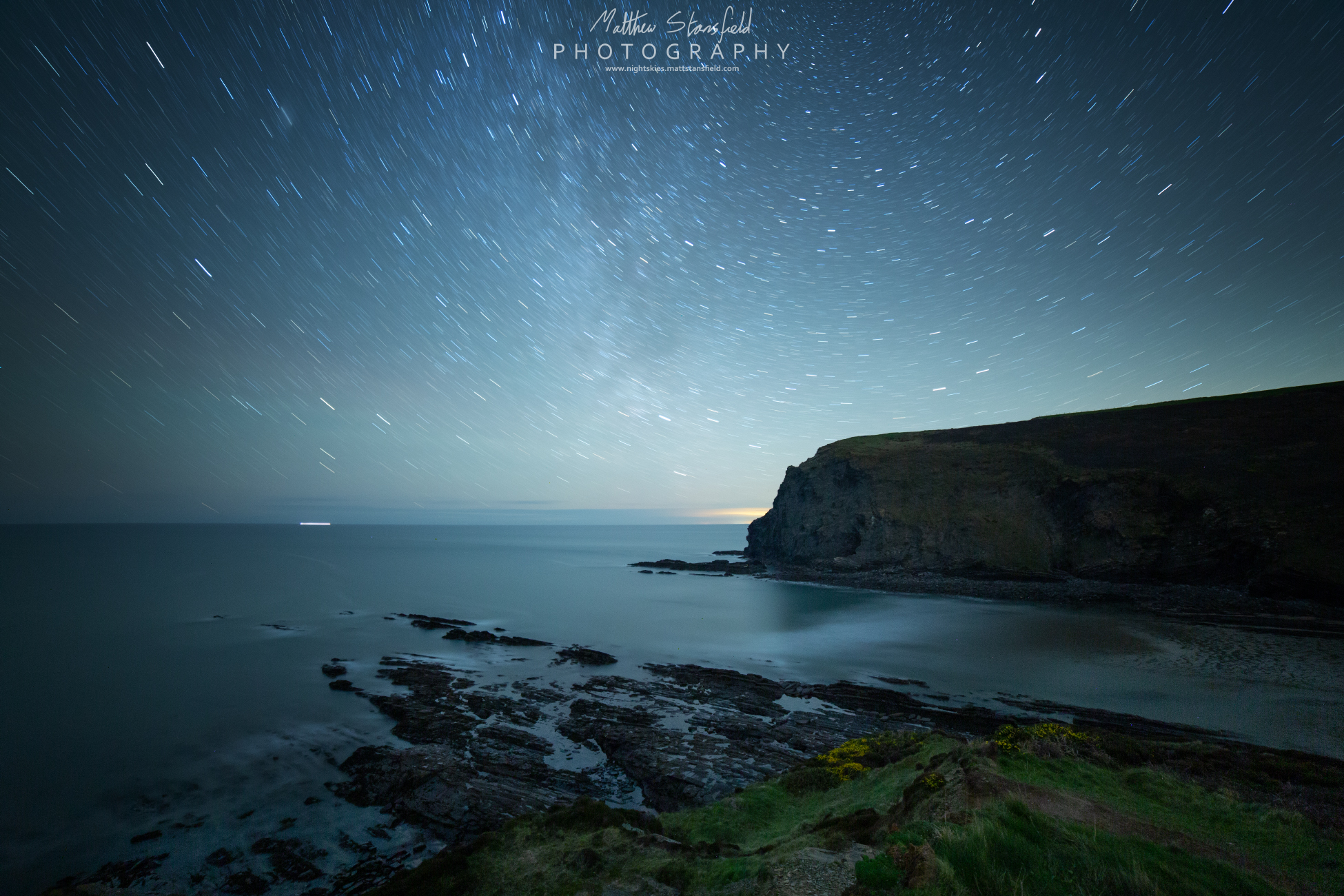
A stone throws away from Hound Tor is this most recognisable Dartmoor Tor, Bowen’s Nose. A unique weathered stack of rocks unlike any of others on Dartmoor. This was my third trip through April, the second trip (which was also to Bowen’s Nose) was a disaster. I misjudge a lay-by and stranded my car when attempting a three-point turn. To cut a long story short I needed to arrange a 4 by 4 to recover my car the following day. So it was nice to re-visit this location without any drama. In my opinion, the best composition faces northerly, so I opted for this star trail capture. Was also fortunate to capture a car trail, adding a bit more interest to the scene.

Bowen’s Nose - Dartmoor

For my fourth trip, I fancied visiting the coast. With a low tide and moonless sky, I thought it a good opportunity to attempt a new location, Holywell Bay. This wonderful beach has plenty of striking features. The first feature I stumbled across was this amazing cave framing the pair of small islands. Just looked fantastic under the starry sky.

Hollywell Bay - Cornwall

My second composition from the night was looking down this rocky stream.

Hollywell Bay - Cornwall

My final shoot of April was a fantastic all night affair down West Cornwall. My first location of the night was at Gurnard’s Head. The moon was still up at this stage of the night, casting a wonderful light over the landscape and headland. I found this group of flowers, which I got low down to wish my wide-angle lens to create this composition.

My second location this night took me west to Porthgwarra. A quaint little cove nestled amount rugged granite headlands. Met up with fellow photographer Jen Rogers for this part of the shoot. My first time glancing at the Milkyway Core this year, and what an amazing dark sky location to watch it. We spend the rest of the night making a few different compositions around the cove until the light of dawn arrived.

March Astrophotography 2021

March proved to be a fantastic month for clear skies and provided a variety of moorland and coastal opportunities for pictures. My first location of the month was Brent Tor. A stunning tor on Dartmoor which has a church on the top. I have visited here a few times previously, and always feel humbled shooting at this location.

Brent Tor - Dartmoor

Brent Tor - Dartmoor

My second trip took me back onto Dartmoor. I explored the northern part of the moor this night around Taw Marsh. I couldn’t believe my luck to stumble upon this striking U-bend in the river which complimented the sweeping views of the moors I thought.

Taw Marsh - Dartmoor

Taw Marsh - Dartmoor

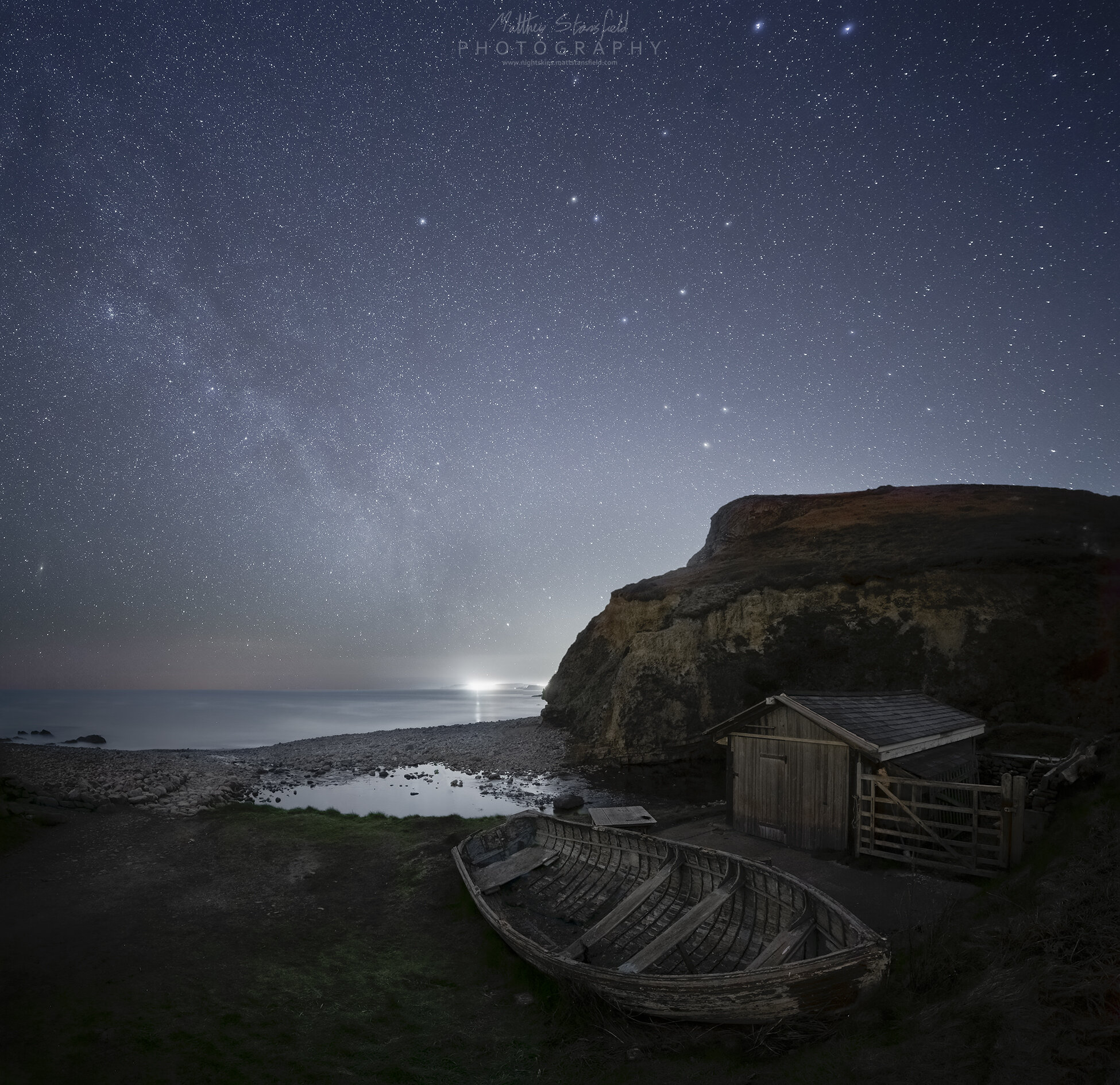
Not wanting to miss out on the favourable conditions, I then drove north to Millook Heaven. A peddle beach not too far from Crackington Haven. I gained familiarity of this stretch off the coast from my surfing days. This quirky old boat made an interesting focal point I thought to this wonderful view looking north up to Bude.

My next location was closer to home. This local beach is on the South Coast of Cornwall. The winter sky was looking incredible this night and I love these types of beaches that are just full of mood and character.

From the same shoot, I decided to add some scale by jumping into the scene. I can easily let my imagination get lost in the sea stars.

My final composition of March featured this beautiful coastal waterfall in the most peaceful corner of South Cornwall. It is so rewarding to experience places like this. Hidden Cornish gems.

February Astrophotography 2021

Astrophotography through February was again still a bit sparse for me. I embarked on four trips. The first being Rame Head featuring the winter sky. Been here many times and also enjoy visiting.

Rame Head - Cornwall

Rame Head - Cornwall

A few days later, I journeyed to the coast by Downderry to rock stack which again looked fantastic with the swirling swell and hint of air glow.

Downderry - Cornwall

Downderry - Cornwall

The following day I journeyed to the small harbour of Portwrinkle. Only being a 20 minute drive, this was an ideal place to visit while feeling astro hungover from the previous night. I searched around the harbour for a focal point and came across this interesting foreground rock with a few lines of quartz cutting through. The winter sky as a backdrop really added to the scene too.

One of my favourite shoots of February, and possibility of the year thus far, was a full moon lit hike to Rocky Valley by Bossiney. It’s tragic to say that I have never hiked the coast under a full moon before and it was a spectacular experience. The atmosphere and mood of the landscape under the light of the moon was magical and complimented this cascading waterfall deep within the valley.

January Astrophotography 2021

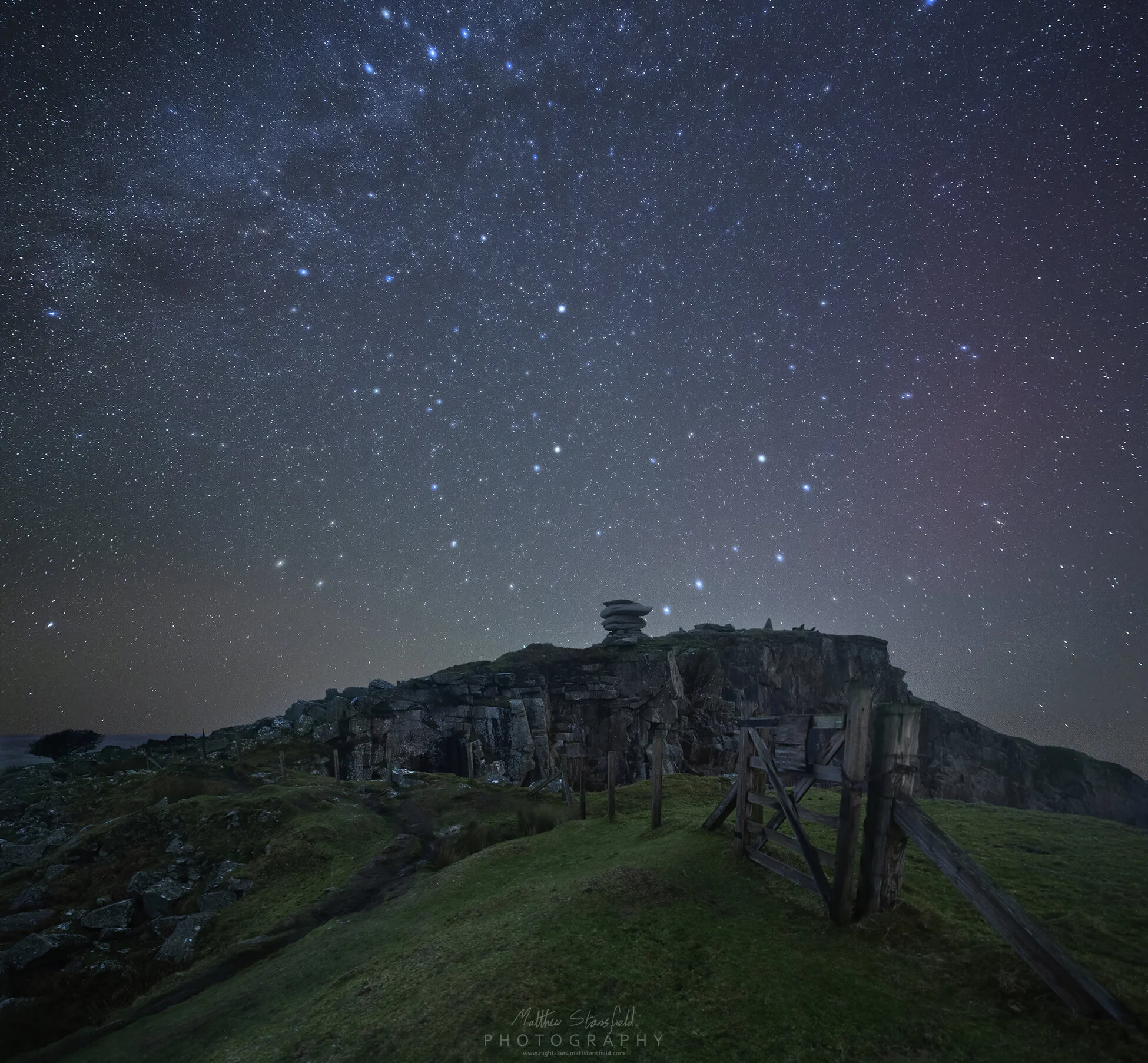
My first outing of 2021 saw me visiting a familiar location, the Cheesewrings. A wonderful area on Bodmin Moor packed with rocky stacks, quarries and character. This particular night was plagued with cloud but the early part of the night had some great starry skies.

December Astrophotography 2020

Through December, I embarked on three astro shoots. The first was a visit to south Dartmoor, the second a trip to the South Devon coast, with the final venture to Exmoor National part. Sitting here typing this blog post, there is a feeling of frustration for Decembers photography, as many clear nights where missed due to work commitments but each of my December shoots where unique, dramatic and without a doubt, worth while ventures!

So the first shoot in early December, involved my friend Lee and I travelling to Leather Tor for a night of shooting the winter sky over Sharpitor and Leather Tor. The conditions were clear as nightfall fell, but the wind was howling and clouds where occasionally rolling over. The elements were certainly testing our resilience. I had scouted a few possible locations around Sharpitor a few days previously, so had a good idea of a few compositions from the top of Sharpitor looking down towards Leather Tor. For this photo, I remember huddling against a rock sheltering from the cold howling northerlies. It was bitterly cold but I think the trip was worth it as I was really happy with this composition!

Sharpitor - Dartmoor

Sharpitor - Dartmoor

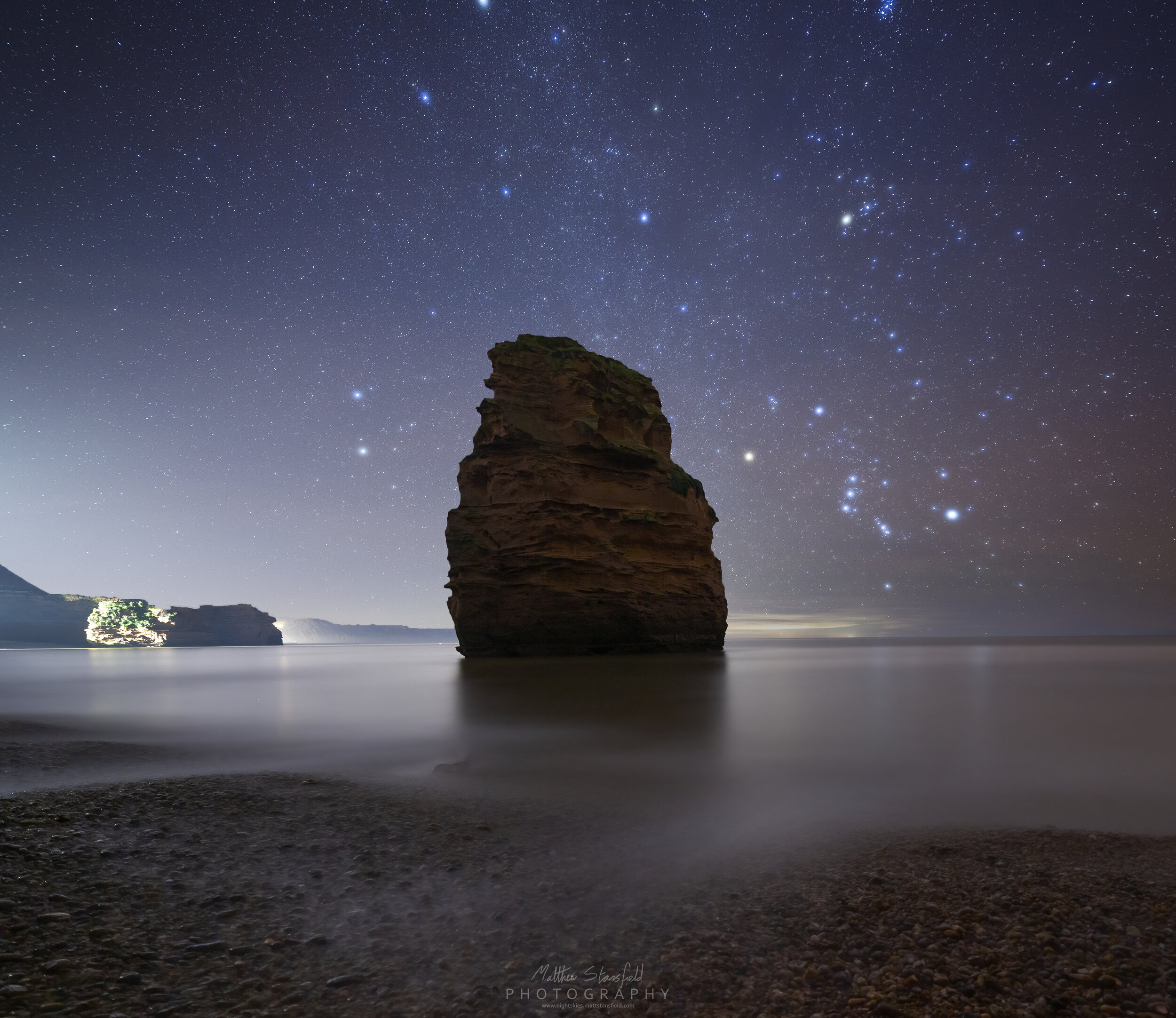
The following night, myself and my girlfriend Cait travelled down to Ladram Bay to enjoy a few hours of moonless clear skies. The conditions where perfect and after a few hundred meters of walking we arrived at our shooting location at the beach. The bay is well know for it’s dramatic rocky stacks and steep peddled beach. The coastal features here looked fantastic against the winter skies. I took a few different compositions featuring the stacks and delighted with how they came out. The photos where a bonus as it was one of those magical nights where time seemed to stand still and it you wouldn’t have noticed the whole night drifting by while enjoying the stars!

Ladram Bay - Devon

Ladram Bay - Devon

Ladram Bay - Devon

Ladram Bay - Devon

My final shoot of 2020 was on Christmas Eve. Keeping with tradition, I was eager to venture somewhere and with an opportunity of clear skies I took a journey to the Valley of the Rocks on Exmoor. This is a stunning stretch of rugged coast with tall cliffs and rocky hills tops. When I arrived the moon was setting, so I opted to make that the feature of my first picture and with some high level cloud, moonset was very dramatic visually.

Once the moon had set, I took another picture with myself in the frame with a flash. Shortly after this, cloud rolled over and the stars disappeared. I spent the next hour exploring the cliffs and found a few more awesome locations I can’t wait to shoot again next time. A great way to sign of a fantastic year of astrophotography! Thank you all for the support this year!

Valley of the Rocks - Exmoor National Park

Valley of the Rocks - Exmoor National Park

Valley of the Rocks - Exmoor National Park

Valley of the Rocks - Exmoor National Park

November Astrophotography 2020

I didn’t manage to get a single shoot done in October, but I did get opportunities through November to venture out twice. On the first night, I opted to sneak out to Dartmoor’s Hound Tor, after work, to make the most of the darker winter evenings. There was only a short window of opportunity this mild, humid night, with moonrise due an hour after the arrival of night. There was cloud bubbling about, but it cleared for long enough for me to capture this composition as the first rays of moonlight kissed the tor as the Milkyway core dipped below the horizon.

Hound Tor in Moonlight.

Hound Tor in Moonlight.

Looking over my shoulder, the moonrise looked striking so for my second composition from this location, I spun the camera 180 degrees around to capture this moonlit view.

Moonrise over Hound Tor.

Moonrise over Hound Tor.

Keeping with the Dartmoor theme, my second and final shoot of November took me to Haytor. The forecast this night suggested a chance of a cloud inversion, and the opportunity to capture this under a starry sky was a strong motivation to give this location a try. The cloud invention wasn’t as intense as I had hoped but still added an interesting element to the composition, and the stars looked fantastic!

Haytor - Dartmoor.

Haytor - Dartmoor.

September Astrophotography 2020

I didn’t manage to do a single shoot through October but the start of September I decided to travel locally to Rame Head and managed to capture this image of the headland chapel and Milkyway core covered in the moonlight. My initial plan was to travel locally to try out a new Star Glow filter although unfortunately I was initially given a dud filter. However, it was nice to get an improved composition of this iconic Southeast Cornwall location.

Rame Head with a hint of moonlight.

Rame Head with a hint of moonlight.

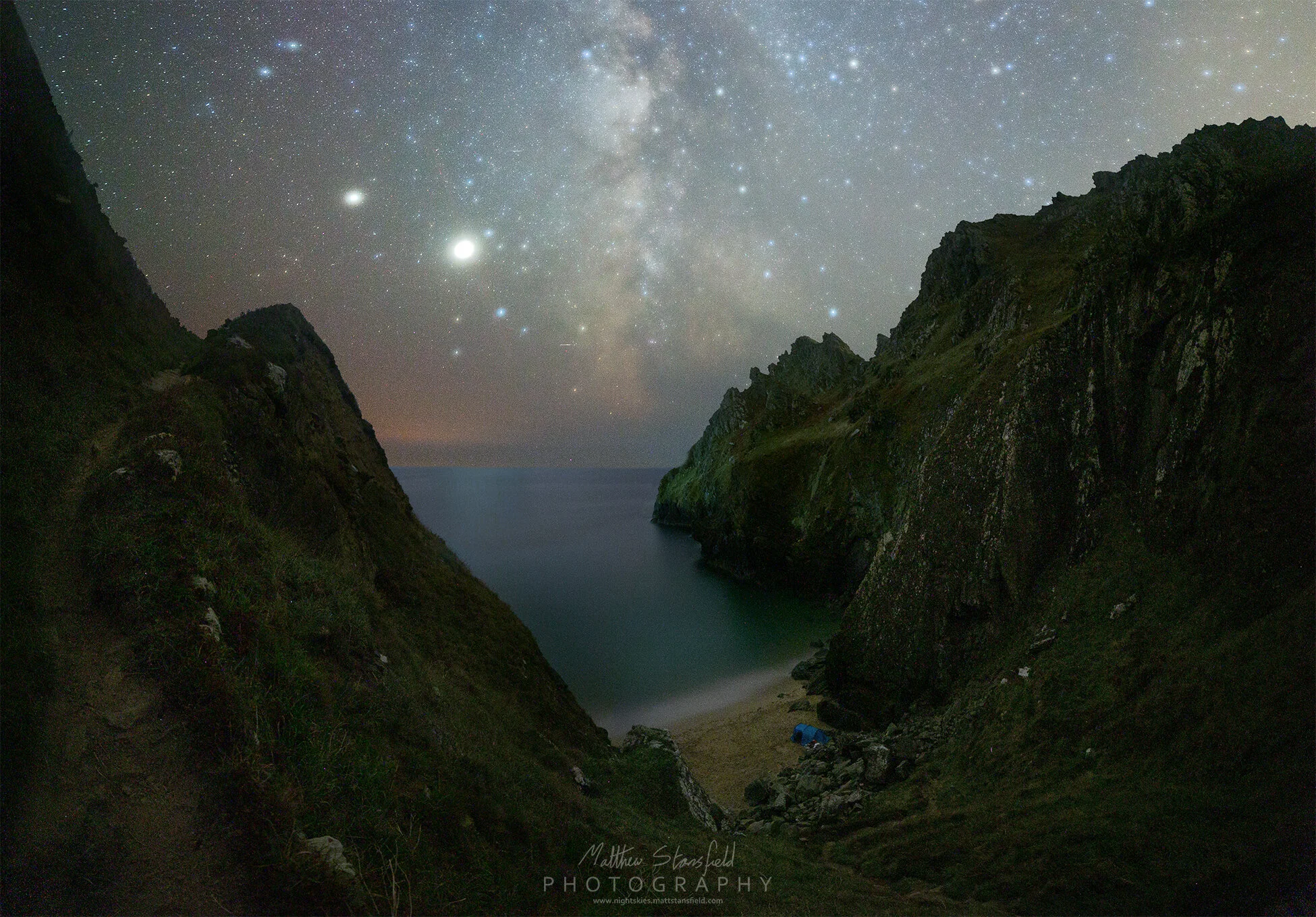
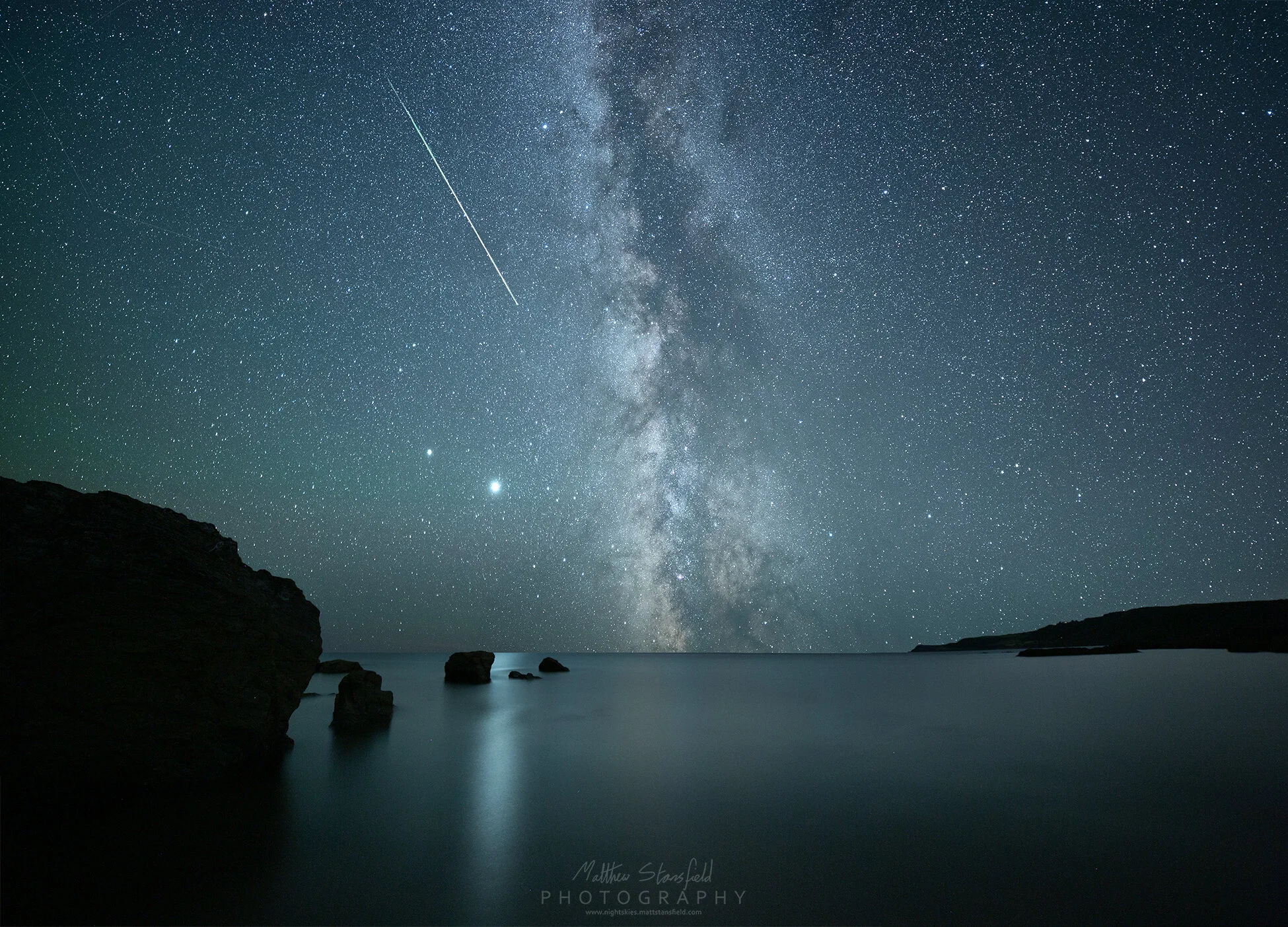
For my second shoot of September, I journeyed to East Prawle. A striking part of the south Devon coast. I have previously explored the coastal path towards Start Point but haven’t been in the other direction. It was particularly nice to wander the coast under such crisp clear skies. This was my first composition from Gammon Head. This cove nestled within the cliffs, jumped out to me immediately once I had approached it from the coastal path. A few lucky campers were enjoying the stars from the beach, so I opted to get this elevated composition from the coastal path with the Milkyway, Jupiter and Saturn acting as a splendid backdrop.

Gammon Head.

Gammon Head.

While venturing around for my astrophotography, I am always keeping an eye open for interesting foregrounds. While walking back to the car this night, I struck gold and stumbled across these interesting Parasol mushrooms. I committed the last few hours of the night making them a focal point for a few more compositions before heading home content on a good nights work.

Parasole Mushrooms - South Devon

Parasole Mushrooms - South Devon

The spell of good astro conditions continued with another coastal trip to Ayrmer Cove. This is an interesting Devon beach which has this shark fin like rock to the west side of the bay. The Milkyway was looking great this night so I got low to the ground to use these foreground rocks as a leading line into the prominent rock stack and milky way.

Ayrmer Cove - Devon

Ayrmer Cove - Devon

My final shoot of September took me to Bodmin for a mild all-night shoot around Kilmer and Sharp Tor. I had no real expectation from this shoot aside from taking a good night walk and seeing what grabbed my eye. This composition was my first taken on the night and features an outcrop on Sharp Tor looking towards the Milkyway. I decided to position myself in the composition to add scale to this Tor. What sticks in my mind about this trip is how still and quiet everything was. I could even hear the flapping of bats wings as they flew around me hunted insects.

Sharp Tor - Bodmin Moor

Sharp Tor - Bodmin Moor

My walk then took me a mile west to Kilmer Tor, which is unique in the sense that it is a long narrow ridge with steep rocky sides. Along this ridge is this interesting rock stack that appears to be defying gravity leaning over to one side. I thought this view of the stack would look great with a Milkyway backdrop.

Kilmar Tor - Bodmin

Kilmar Tor - Bodmin

My third and final location this nigh took me to this water-filled quarry. I like to achieve three compositions on a night shoot and this composition was one of my targets after a day scout a few days previous. It was nice to get a shot of the northern skies too and to sign off a great month off astrophotography.

Minions Quarry - Bodmin

Minions Quarry - Bodmin

July Astrophotography 2020

July provided one of the most epic months for astrophotography for me. Mostly due to a visit to our skies of comet Neowise. A magical comet that surprised and amazed stargazers across the globe. My first sighting came from a trip to Botallack Mines on the wild west coast of Cornwall. This location is famous for a pair of engines houses perched on cliffside close to the water’s edge. I travelled down with a few companions, and we set off to make the most of the clear conditions. My first image from the night was actually looking the opposite way of the comet towards the Milkyway.

Botallack Mines and the Milkyway

Botallack Mines and the Milkyway

Shortly after this composition, I walked along the coastal path to a northerly viewpoint for the comet. It was difficult finding a good composition but I stumbled across this quaint cottage which lined up with the comet which was now high in the sky. I didn’t quite realise the moment at the time but reflecting back, I probably won’t see a sight like this for another 10-15 years!

Comet Neowise.

Comet Neowise.

Believe it or not, the night still wasn’t over. We wanted more from the night, so wandered the short distance to Pendeen Lighthouse, where not only did we capture the comet over the lighthouse, but we were also treated to a fantastic and rare display of noctilucent clouds. This was an award-winning image from the Alyn Wallace Instagram contest and a mind-blowing experience.

Pendeen Lighthouse.

Pendeen Lighthouse.

My second shoot of July arrived a few days later and kept with the lighthouse theme with a trip to Trevose Headland. Cornwall and Devon's weather is unreliable at best and with this amazing and rare visitor in comet Neowise, I felt it important to make the most any clear conditions. This location worked well compositionally with the position of the comet I thought.

Trevose Lighthouse and Comet Neowise.

Trevose Lighthouse and Comet Neowise.

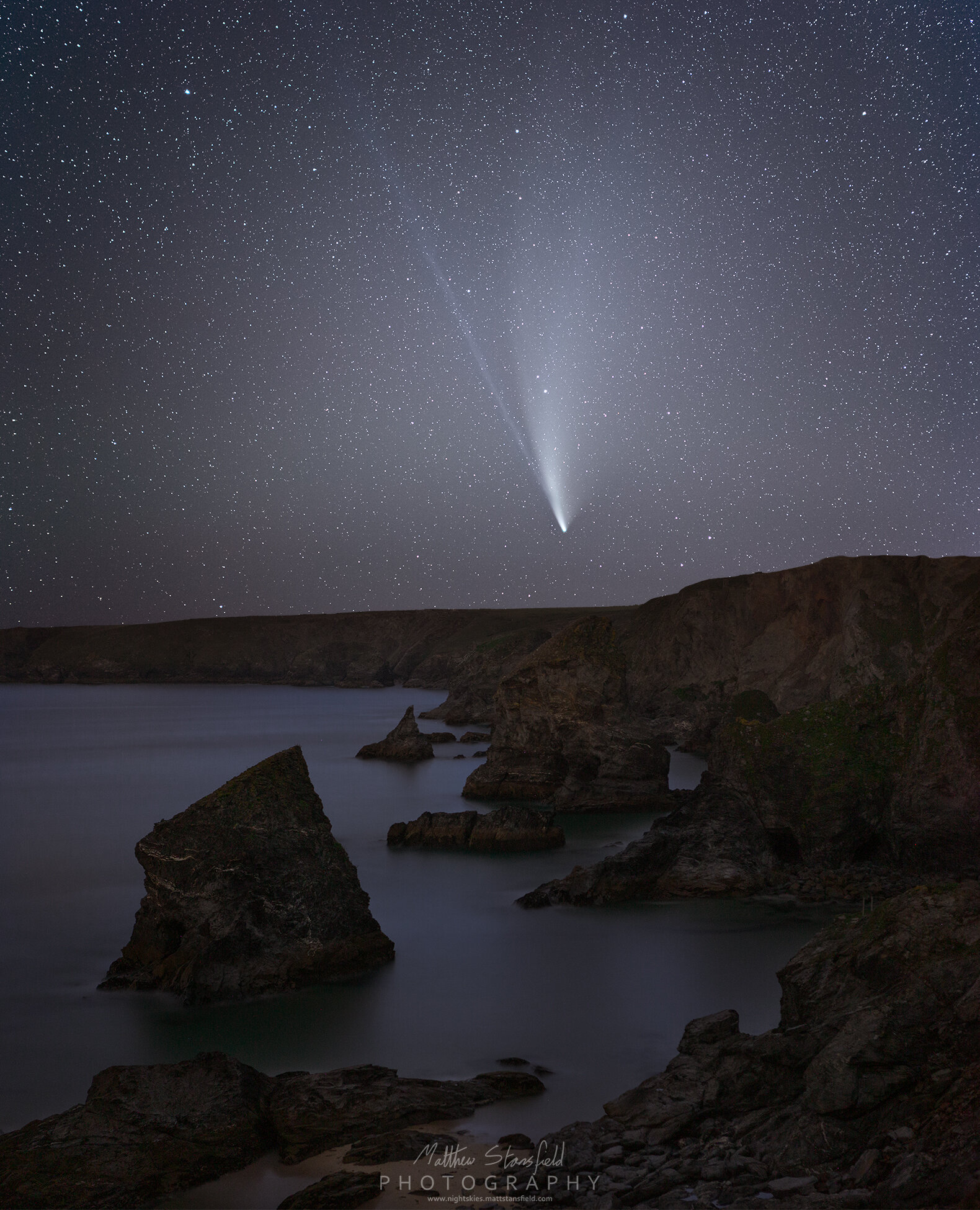
Later the same night, I travelled down the coast to Bedruthan Steps for my second locations. I have shot this composition before and thought I would try again with the added feature of Neowise. The skies are incredibly dark on this part of the coast, and the tail of the comet looked fantastic.

Bedruthan Steps and Comet Neowise.

Bedruthan Steps and Comet Neowise.

Comet Neowise over Bedruthan steps.

Comet Neowise over Bedruthan steps.

My third shoot of July took me to south Devon’s Termite Bay. A beautiful beach nestled in the shadow of Start Point. I was delivering a workshop this night but took a few pictures after the sessions.

Great Mattiscombe Beach.

Great Mattiscombe Beach.

Milkyway over Mattiscombe.

Milkyway over Mattiscombe.

For my final shoot of July, I travelled to Crackington Haven. A location on the north coast of Cornwall which I have explored on many occasions. The Milkyway core is westerly in the sky this time of year and lines up nicely to the headland. I placed myself in the scene too, to add some scale to this epic viewpoint. A good way to sign off an awesome month of Astrophotography.

June Astrophotography 2020

Through June, I visited Cape Cornwall, Start Point and Dartmoor. All three shoots where all-night affairs with quality astrophotography conditions. The first trip was an hours journey to the rugged, dramatic coast of West Cornwall. The cold granite cliffs and hidden coves make it a magical place to shoot under the stars. Our desired shooting location was a rocky headland towering over Porth Ledden, about a 30-minute hike along the coastal path from the car. The skies were starry, striking and surreal with only a hum of a teenage rave on the cliffs breaking the silence.

The Milkyway, Jupiter and Saturn over Cape Cornwall.

The Milkyway, Jupiter and Saturn over Cape Cornwall.

After a few hours on the headland, we hiked to Kenidjack Castle as our second location. This is an interesting ruin highly elevated which looked amazing with the Milkyway Backdrop. This night being the summer aquanauts meant the hours of darkness were short and we had to rush to make the most of this second location. Soon enough, the light of dawn would be upon us.

Kenidjack Castle.

Kenidjack Castle.

To finish off this night, we where treated to a magical display of Noctilucent Cloud glistening like spiders silk on the northern horizon. The display intensified as dawn approached, my third ever sighting of this striking phenomenon.

_MG_0203-Pano.jpg

My second jaunt took me and my friend to Dartmoor. We ventured to a remote part of the west Moors travelling over Brat Tor to a remote ruin. Skies looked unbelievably clear and dark. I love the concept of ruins, time and stars and felt this scene fitted in well to that. Didn’t take many photos this night but it was great to chill under the stars on this warm clear night wondering on the story to this place.

Brat Tor Ruin under t he watch of the Milkyway.

Brat Tor Ruin under t he watch of the Milkyway.

My concluding shoot of June took place on the south Devon coast to an amazing beach I’ve nicked named termite bay. This is a sentimental place for my and my partner Cait and ranks in my top three Cornwall and Devon beaches. This cove is nestled along side Start Point and this night the skies where breathtakingly salient, clear and striking.

A few beach campers enjoying the starry skies with Jupiter and the Milkyway.

A few beach campers enjoying the starry skies with Jupiter and the Milkyway.

After capturing a few images from the cliff, I wandered down to the beach to photograph some waters edge details. My final image of the night and a fantastic way to sign of a good month of Astrophotography

Mattiscombe Beach.

Mattiscombe Beach.

May Astrophotography 2020

Astrophotography through May featured five trips. Mostly around the Moors but also one venture to the coast. My first trip featured Leather Tor and Nun’s Cross Farmhouse. This was a peaceful, calming warm summers night with crystal clear skies.

_MG_8933-Edit.jpg

My initial plan was to shoot the rocky outcrop close to this tent, but after literally tripping over a couple who where ‘star gazing’ amongst the rocks and giving them a fright, I thought it wise to give them some space and shoot from Leather Tor instead. Not a bad alternative view looking over Burrator Reservoir.

Leather Tor, Sharpitor and Peek Hill.

Leather Tor, Sharpitor and Peek Hill.

Once all was settled with the campers, I wandered back down to the original viewpoint and stumbled across this wonderful view looking back towards Sharpitor.

I then wondered a few miles to my second locations, Nun’s Cross Farmhouse. A quirky and photographic building deep into the open Moor. By this time, the early hours of the morning were upon us. I worked quickly to get two compositions, but the challenge was the most favourable view of the Farmhouse didn’t match the most favourable composition of the sky. However, I was pleased with how these shots came out.

The Milkyway arching over Nun’s Cross Farmhouse.

The Milkyway arching over Nun’s Cross Farmhouse.

The “classic” composition of this well photographed farmhouse.

The “classic” composition of this well photographed farmhouse.

I travelled to the south coast and Gribbon Head for my second shoot of May. This stretch of the coast has plenty of meaning and memories for me. With clear moonless skies forecasted my hopes were to capture a few compositions featuring the Milkyway above the dramatic coastline here.

_MG_8989-Blog.jpg

On my way back to the car, the first light of Nautical twilight was fast approaching but I was eager to get a final composition. By this time of the night, Jupiter was low on the horizon and reflecting wonderfully over the ocean. This panorama was probably my favourite shot of the night.

Polridmouth

Polridmouth

April Astrophotography 2020

April involved three astrophotography adventures. The first was at a part of the North Cornwall coast called The Strangles. This stretch of coastline is dramatic, rugged and expansive. It reminds me a little of the landscape in Jurassic Park with the terrain and vegetation. It is a beautiful secluded place and looked wonderful under crisp starry skies this night. My first image form the evening was taken from the steep narrow winding path that took you to the beach. I like to achieve some elevation in my compositions and this viewpoint looked great with Venus shining brightly over the turbulent ocean.

_MG_8750-Edit.jpg

I then wondered to the waters edge and took this final image of the night.

_MG_8752-Edit.jpg

My second shoot of the month was locally in my home town of Saltash. Light pollution was terrible but it was nice to venture out closer to home.

Church Town Far - Saltash

Church Town Far - Saltash

My final shoot was a substantial night hike across Dartmoor exploring the valley and tor’s around Tavy Cleave. A place I am familiar with but appears different and new every time. This night was magical with the darkest skies I have seem so far this year. My aim was to capture some photographs of the waterfall and then climb up to the summit of the valley for an elevation view.

Tavy Cleave Waterfall - Dartmoor

Tavy Cleave Waterfall - Dartmoor

After spending an hour or so getting different compositions of the river I climbed up the valley for a different viewpoint. By the time the Milkyway Core was beginning to rise and made a great sky backdrop.

Tavy Cleave Valley - Dartmoor

Tavy Cleave Valley - Dartmoor

February & March Astrophotography 2020

The skies and conditions through February weren't amazing, but I did manage to venture out one clear night to the coast of Devon to photograph the coastline at Thurlstone.

Orion and Venus looking spectacular over Thurlstone Beach.

Orion and Venus looking spectacular over Thurlstone Beach.

Thurlstone rocky foreshore.

Thurlstone rocky foreshore.

Thurlstone Beach.

Thurlstone Beach.

Unlike February, March provided some amazing clear skies but also the beginnings of the pandemic. With a cloak of uncertainly over normal life, astrophotography through March became an important outlet for me to maintain an area of normality amongst all the change. My next location was Hartland Quay on the north Devon Coast. A beautiful stretch of coastline with no shortage of photogenic coastal viewpoints.

Upright Cliff Waterfall and Orion.

Upright Cliff Waterfall and Orion.

This night was particularly windy and with a lapse of concentration, my tripod toppled shortly after this shot was taken, breaking my trusted Samyang lens into two. Wanting to savage the night, I continued up the cliff looking for a second compositions and found this viewpoint which ended up becoming an award winning image.

Looking along the North Devon coastal path towards Hartland.

Looking along the North Devon coastal path towards Hartland.

My next trip saw me travel to North Devon’s Westward Ho in search of this striking shipwreck. This was a risk, as the shifting sands often covered the wreck so there was no guarantee we would see it. Fortunately, after a bit of searching, we were treated to this spectacular view.

Westward Ho Ship Wreck.

Westward Ho Ship Wreck.

On the journey back home from Westward Ho, I decided to stop off a Brent Tor Church on the western side of Dartmoor to capture an early morning Milky Way photo. I also find this a humbling place to visit, especially in the peaceful hours of the early morning.

Brent Tor Church and the Milkyway.

Brent Tor Church and the Milkyway.

My third night of astro this month saw me visit the coast again, but this time at my local beach Downderry. I didn't have a lot of free time this evening, so this was a quick grab and dash type of shoot. However, it is always amazing to spend time under the stars, if only for an hour or two.

The dramatic rocks of Downderry Beach always make for some interesting waters edge compositions.

The dramatic rocks of Downderry Beach always make for some interesting waters edge compositions.

My final shoot of March involved travelling down to Lizard Point to photograph the last of the winter skies before the summer constellation started dominating the skies again. I decided to spend the night at the Lizard boat ramp. Skies where the clearest I had seen this year. Incredible to see such dark and starry skies and a nice way to end a month of good astrophotography.

Old lifeboat ramp at Lizard Point.

Old lifeboat ramp at Lizard Point.

January Astrophotography 2020

January was an interesting month for astrophotography. The new year always provides a feeling of a new start and a renewed drive to work on fresh projects. My first shoot took me to the North coast of Cornwall and the ruins at Chapel Porth, which looks stunning under the winter Milkyway Way.

Chapel Porth

Chapel Porth

Wanting to make the most of the clear conditions, I decided to journey along the coast to Godrevy as my second location. Wanting to get close to the water’s edge, I remember clambering along the jagged rocks and negotiating the narrow gullies, which would occasionally be filled with surging seawater as the swell engulfed the foreshore. The retreating tide provided some security and it felt awe-inspiring to be amongst the elements under such a brilliant starry sky.

Godrevy Lighthouse

Godrevy Lighthouse

Godrevy Lighthouse & Andromeda  Galaxy.

Godrevy Lighthouse & Andromeda Galaxy.

The following day, I travelled closer to home to Colliford Lake. This is a vast body of water on Bodmin Moor most renowned for its waters edge dead trees. Visiting here always makes me feel a bit sad. I am certain these trees had a story and seeing them as no more than a shadowy imprint on the landscape is humbling. I feel astrophotography naturally lends itself to the concept of passing time and these trees as a subject, fitted this concept well I thought.

Colliford Lake.

Colliford Lake.

My final shoot of January took me to Whitsand Bay. This sandy stretch of coast is a striking part of south-east Cornwall and is littered with interesting old shipwrecks. On this night, I opted to try and photograph a few under the winter sky. This was my favourite from the night.

Boiler Beach - Whitsand Bay.

Boiler Beach - Whitsand Bay.

March Astrophotography 2019

March consisted of a flurry of Five awesome astro shoots. These featured meeting up with Plymouth photographer Ben McConnon and Canadian photographer Esme Battern before her return home. A few of my favourite photographs below.

The first shoot of March took place at Wembury Beach close to Plymouth. I met up with Ben and we spent a few hours photographing the winter sky from beach.

The first shoot of March took place at Wembury Beach close to Plymouth. I met up with Ben and we spent a few hours photographing the winter sky from beach.

This was the scene from myself and Esme’s final shoot together at Aymer Cove. Roughing it all night in the car paid off with an incredible view of the Milky Way in the early hours of the morning.

This was the scene from myself and Esme’s final shoot together at Aymer Cove. Roughing it all night in the car paid off with an incredible view of the Milky Way in the early hours of the morning.

For my next venture, I travelled west to Portreath. Meeting up with photographer Matt Mario, we spent a few hours photographing this dramatic part of the coast as Orion sunk below the horizon.

For my next venture, I travelled west to Portreath. Meeting up with photographer Matt Mario, we spent a few hours photographing this dramatic part of the coast as Orion sunk below the horizon.

My fourth shoot took me locally to Whitsand Bay.

My fourth shoot took me locally to Whitsand Bay.

My final shoot brought me to the stunning coastline of Black Church Rock.

My final shoot brought me to the stunning coastline of Black Church Rock.

February Astrophotography

The month of February saw me embark on four stella astro shoots. The first was a local shoot at Long Stone Beach. A remote beach shadowed by a steep woodland covered cliff, found on the east end of Downderry, twenty minutes from where I live. To the east end of this beach is a dramatic rock stack called Shag Rock, which made for the focal point of my shoot here.

The shoot felt rushed with the relentless incoming tide, and precarious as the layout of boulders meant that to achieve a clean composition, I had to balance on a four foot high and meter wide boulder. I remember the sky being brilliantly clear with the polar white and birthstone-blue stars gleaming and glittering spectacularly through the cold winter air. It was a spectacle of nature I'll never tire of experiencing.

Shag Rock - Tracked sky exposure, ISO 800, f2.8, with a 240-second exposure. The foreground exposure was ISO 1600, f2.8, with an exposure of 320 seconds.

Shag Rock - Tracked sky exposure, ISO 800, f2.8, with a 240-second exposure. The foreground exposure was ISO 1600, f2.8, with an exposure of 320 seconds.

My second shoot came on the back of an epic day hike and climbing around the Lizard peninsular with my Canadian friend and fellow astrophotographer, Esme. Through the day hike, we scouted a couple of striking compositions, some of which after camping out in the car, we re-visited once darkness fell upon us.

The dark skies and winter constellations looked incredible. Definately some of the darkest winter skies I have seen, and it was great to get some pictures from our excursion to West Cornwall.

Lizard Point - ISO 800, F2.8, 240 seconds for the sky. ISO 1600, F2.8, 320 second exposure.

Lizard Point - ISO 800, F2.8, 240 seconds for the sky. ISO 1600, F2.8, 320 second exposure.

My third shoot took place at Dartmoor's Foggingtor Quarry and again, I teamed up Esme. The shoot was a one composition trip where I wanted to capture this exciting place under a winter sky.

The sky this night looked magnificent, peaceful, and dreamy. Orion was shinning dramatic to the southwest, and the views over the quarry were vast and spectacular. The same couldn't be said with the relentless wind battering our position. We were able to huddle under this piddling rock feature, which provided some comfort from the elements while our cameras did their work.

Foggingtor Quarry - ISO 800, F2.8, 240 seconds for the sky. ISO 1600, F2.8, 320 second exposure.

Foggingtor Quarry - ISO 800, F2.8, 240 seconds for the sky. ISO 1600, F2.8, 320 second exposure.

My last astro adventure from February involved journeying the hundred odd miles to the Dorset coast to meet up with Dorset photographers Phill & Tim, for a night astro at Kimmeridge Bay. Kimmeridge was a location I haven't been to before, so it was fantastic to shoot somewhere new with the guidance of local photographer Phill. An excellent way to end a good month of astrophotography!

The much photographed ledge at Kimmeridge Bay- ISO 800, F2.8, 240 seconds for the sky. ISO 1600, F2.8, 320 second exposure.

The much photographed ledge at Kimmeridge Bay- ISO 800, F2.8, 240 seconds for the sky. ISO 1600, F2.8, 320 second exposure.

Kimmeridge Bay - ISO 800, F2.8, 240 seconds for the sky. ISO 1600, F2.8, 320 second exposure.

Kimmeridge Bay - ISO 800, F2.8, 240 seconds for the sky. ISO 1600, F2.8, 320 second exposure.

Kimmeridge Bay - ISO 800, F2.8, 240 seconds for the sky. ISO 1600, F2.8, 320 second exposure.

Kimmeridge Bay - ISO 800, F2.8, 240 seconds for the sky. ISO 1600, F2.8, 320 second exposure.

Kimmeridge Bay - ISO 800, F2.8, 240 seconds for the sky. ISO 1600, F2.8, 320 second exposure.

Kimmeridge Bay - ISO 800, F2.8, 240 seconds for the sky. ISO 1600, F2.8, 320 second exposure.

January Astrophotography

January was a fantastic month for my astrophotography. I embarked on seven incredible shoots around the Cornwall and Devon coastline as well as spending an evenings up on Dartmoor. I can’t remember a month that was so positive for clear skies and favourable conditions.

Another highlight for me was meeting an incredible photographer and human, Esme, and being able to share some of these shoots with her.

Soussons Stone Circle - Dartmoor

My first location of the year was just outside Postbridge and sits on the edge of Soussons Down Woods. Photographing Dartmoor's Stone circles at night has been an ongoing subproject, and it was great to add a new addition to this collection. You can read a bit more about my Dartmoor mini projects here: 

https://www.nightskies.mattstansfield.com/…/dartmoor-the-pr…

The forecast wasn't confident for crisp, clear skies this night, but my aim for 2019, is to take more risks in photographing when our changeable weather isn't looking perfect. Being out on winter nights like this is always rewarding regardless of the photography, and it was surreal to watch the winter constellations slowly trekking across the dark blue sky above these beautiful woods

This photograph was, in fact, my last composition of the night where I was interested in adding a human element to the scene with some dramatic light. You can see the constellation of Orion just clipping the treetops, with a threatening bank of cloudly stubbornly holding out to the west, reflecting the glow from nearby towns.

Soussons Stone Circle

Soussons Stone Circle

Hartland Point Lighthouse

My second shoot from January involved meeting up with photographer Esme, for the first time, and wandering to Hartland Point Lighthouse on the north Devonshire coast. The Quadrantids meteor shower was peaking on this night, so we intended to photograph some of these with the Lighthouse as an interesting foreground.

Once we arrived and begun walking the windy coastal path in search of an elevated viewpoint, I remember being mildly concerned with the cloud cover, but there were gaps, and the meteors were flashing by through the openings dramatically. It was also bitingly cold, so we worked quickly and kept our spirits warm through conversation while capturing some striking images. The first of many memorable night adventures we would embark on in the coming months.

Heartland Point Lighthouse

Heartland Point Lighthouse

Great Staple Tor

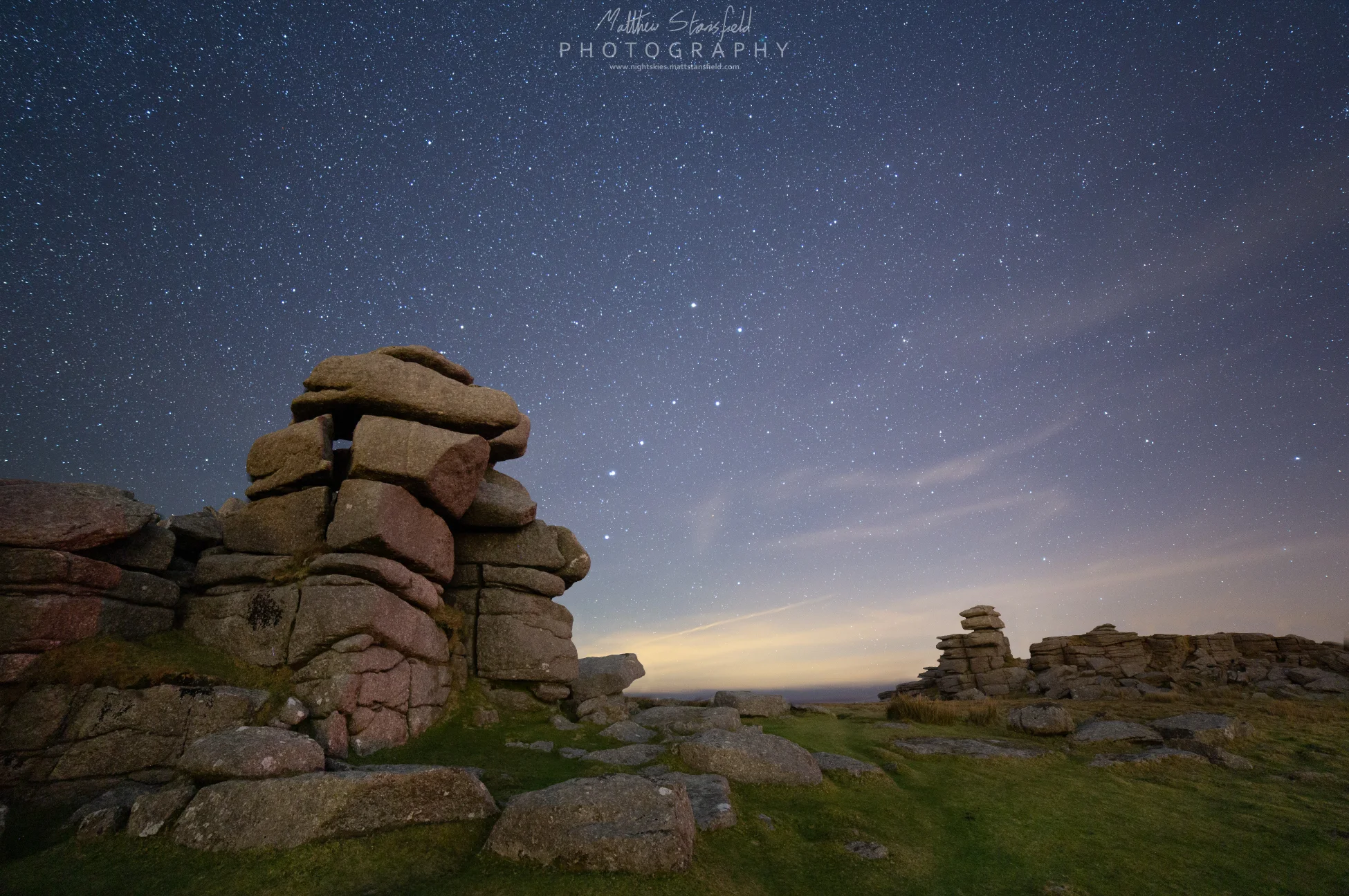
The following night, Esme and I met up again in our pursuit for clear skies and exciting locations. This time we decided to photograph Great Staple Tor. A dramatic place I know well, but which I have never shot under the winter sky previously.

Cloud initially concerned me again while we journeyed up, but as is often the case with the Moor's elevation, clear skies can prevail wherein lower locations, it may linger. Spectacular clear skies greeted us when we did arrive, and I recall the winter circle glistening beautifully about the main stack.

We worked a few different compositions, star gazed and exchanged chat — a perfect night.

Great Staple Tor - Dartmoor

Great Staple Tor - Dartmoor

The mandatory flash lite Selfie

The mandatory flash lite Selfie

Great Staple Tor - Dartmoor

Great Staple Tor - Dartmoor

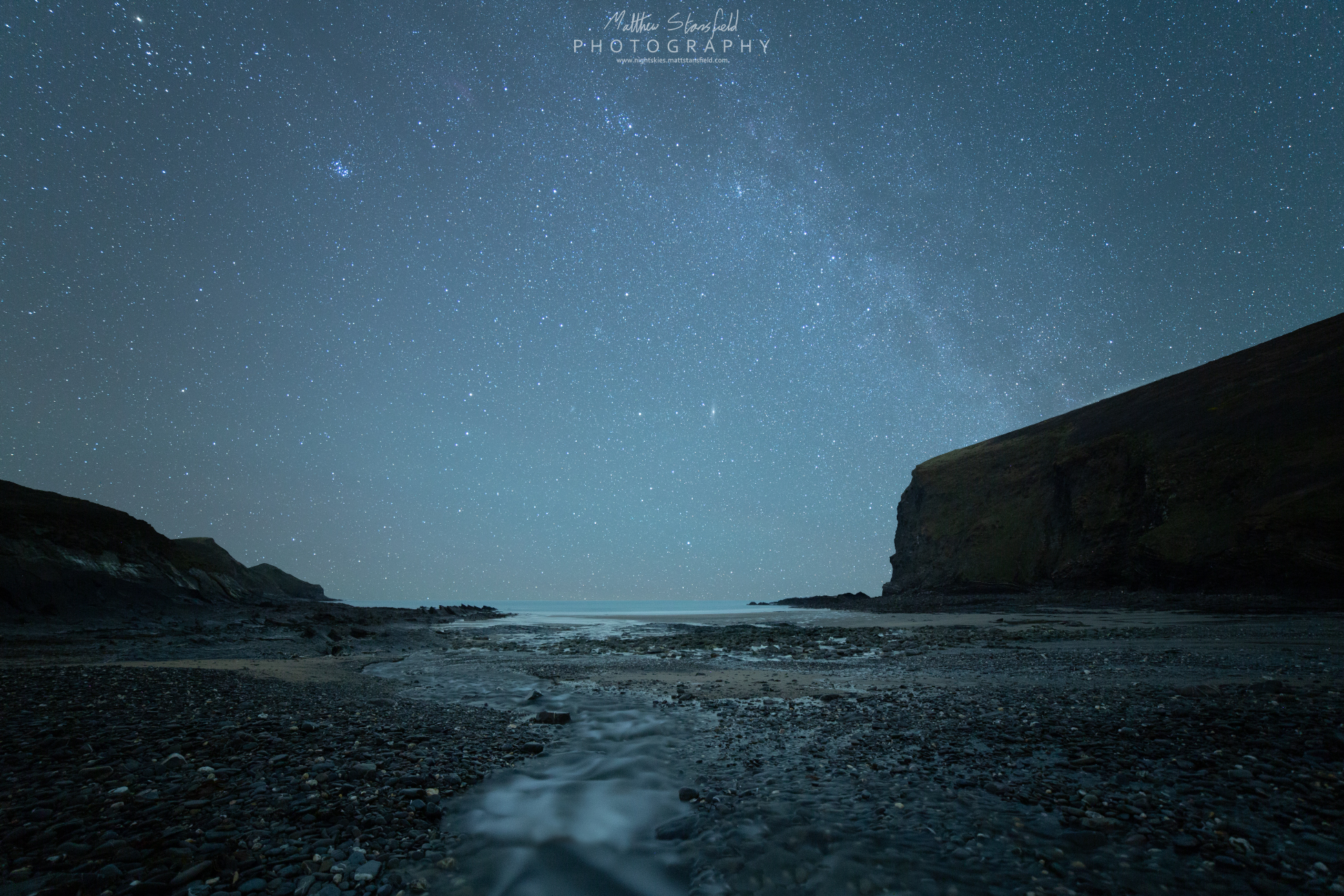
Crackington Heavan

About a week later, I spent a dreamy ice cold night at Crackington Haven. The clearest darkest skies I've experienced for some time in Cornwall.

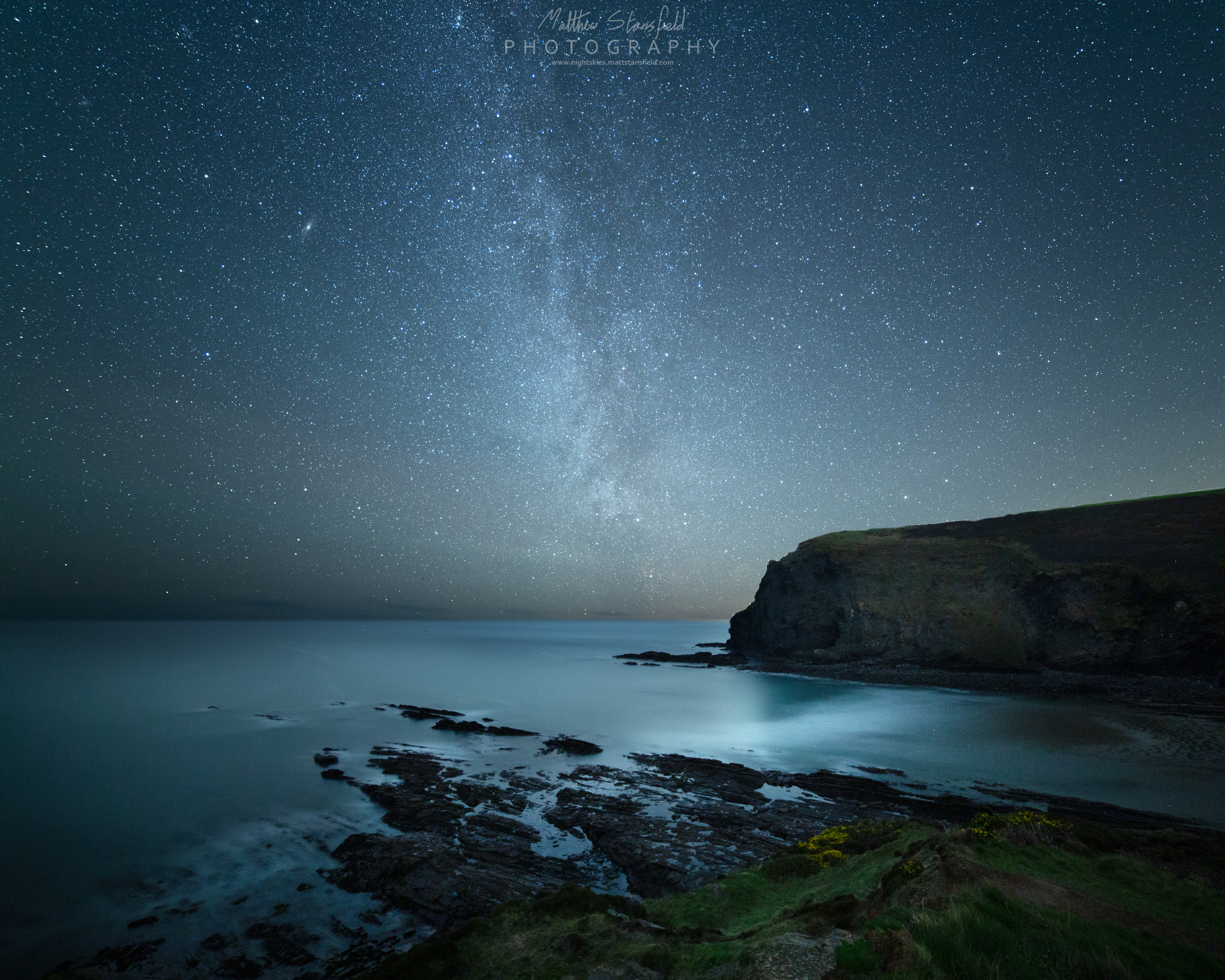
There was a lot in the sky this night for us to enjoy including the Andromeda Galaxy, the star cluster Pleiades, and of course the winter sky superbly glistening above the rugged coastline.

Rumps Point Lunar Eclipse

My fifth shoot in January was extraordinary. Early Monday morning, Esme and I journeyed to the north Cornwall coast to photograph and experience the much anticipated lunar eclipse. 

I previously photographed a close-up sequence of a lunar eclipse a few years ago, so wanted to capture a wide angles nightscape with the moon as an element to the overall composition rather than the main focal point.

Typically, the timing of totality was very early in the morning, and on a working weekday, with a high-risk of cloud interfering, it all sounded a perfect combination of circumstances to warrant a trip! A few hours kip after arrival on location certainly helped and we were alive for an exciting event. We chose to visit Rumps Point, as it was an impressive location with dramatic rugged cliffs and importantly dark skies.

It is interesting, because sometimes as a photographer, my impression of an image is influenced by my experience at the time of taking a photograph. I am not sure if this is particularly good from a composition standpoint, but for me, this photographs represents the excellent company, steep moonlit trails, incredibly crisp dark skies, and a powerful sense of peace and tranquillity. What an enjoyable start to 2019 chasing dark skies!

Rumps Point

Rumps Point

Portwrinkle

About a week later, we ventured to a local beach called Portwrinkle on the southeast corner of Cornwall. I enjoy photographing placing close to home; it's nice to be able to shoot and not need to journey hours to reach home.

This particular night wasn't perfect; it was hazy with high-level cloud but a few hours well spent.

Portwrinkle Harbour

Portwrinkle Harbour

Dartmoor

My final shoot of January, saw me take a solo trip to snowy Dartmoor to photograph the few locations around Sharp Tor and the Dart River.

The night began with a dash from work, full of motivation to have an adventure, or just get lost somewhere within the expense of Dartmoor. I find a strange comfort in the coldness of the moors in the wintertime, so this was my obvious choice. The plan was to trek a 5km circle around Mel Tor, Luckey Tor, and up to Sharp to explore a few places I have previously scouted.

The night was beautiful, the crunchy snow crackled beneath my feet, you could hear owl calls echoing in the dark, and the hum of the mighty River Dart below the peacing stars glistening blissfully above.

For the first time in a while, I actually felt haunted wandering around, been a while since I have ventured out somewhere this isolated solo, but it was refreshing too.

What a month for astrophotography!

Snowy path looking towards Sharp Tor.

Snowy path looking towards Sharp Tor.

The winter sky

The winter sky

Lucky Tor

Lucky Tor

The Dart Valley

The Dart Valley

October Milky Way - Rame Head & Whitsand Bay

I have decided to embark on a mini project photographing beaches, headland, cliffs and coastal features around south east Cornwall. Work commitments have depleted most of my free time and reduced opportunities, to venture far afield, to chase darks skies. However, I have relished the opportunity to photograph closer to home and re-visit some locations, as well as finding some new places to photograph.

My first trip for this project was to Rame Head. A popular local headland landmark standing dominantly at the east end of the sandy bay of Whitsand. A place I have visited before, but not with the tracker. On this night, the window of dark skies was short between the last light for sunset and moonrise.

The Milky was in the southwest sky, so I had two compositions in mind. The first was capturing the small chapel on top of the windswept headland with the Milky Way glistening brightly to the right.

ISO 1600, F2.8, 420 Second exposure.

ISO 1600, F2.8, 420 Second exposure.

My second composition was rushed, with 200 seconds of the exposure being after moonrise! I wanted a central composition of Rame Head, but the inclusion of the ocean on either side. I don’t think this will be a portfolio piece but a nice addition to the project.

ISO 100, F2.8, 420 seconds

ISO 100, F2.8, 420 seconds

A few days later, I decided to journey to neighbouring Whitsand Bay. A long stretch of beach at low tide, which forms many small interesting covers at high tide.
ISO 800, F2.8, 240 Second tracked exposure

ISO 800, F2.8, 240 Second tracked exposure

What caught my eye with this composition, was the elevated perspective looking down towards Sharrow Point. This night was my favourite of the two shoots. The star sparkled vividly with a calm vibe deserting all around, as night took hold.

_MG_9413-Edit.jpg

For my final image of the night and most recent photo to date, I climbed down to the beach to attain a waters edge composition of Sharrow Point leading out to the Milky Way. My next location is LongStone beach, for when the nights get clear again, is Longstone beach.

Durdle Door - 20.10.18

I like to visit Durdle Door at least once a year. Being a 200 miles round trip, from my base in Saltash, it’s not a location I can regular visit. The conditions where set for a typically astro adventure; with only a 2 hour window between moonset and astronomical twiligh; uncertain weather, and four hours of driving to looked forward to! This was also going to be the first real test for my new Star Tracker and Samyang 14mm lens.

Normally, you would navigate your way through the campsite to reach the beach or coastal path. However, they have created a bypass around the campsite through a dark woodland, which was convenient but slightly unsettling.

Once through the woods, I reached the gravely windy path that snacks down to the cove. My eye was immediately drawn to the moon setting beautifully over Weymouth Bay in the distance. The reflection glistened on the glassy ocean like a flame flcikering in the wind. It was quite a sight to behold and set the scene for a amazing night under the stars.

I already had my first composition in mind; a view from the top of the cliffs, looking down at the famous rocky arch. In fact, I have shot a similar composition before featuring the Milky Way. However, tonight was all about the winter constellations, which I hoped would align nicely in the sky behind the arch.

Durdle Door - Sky exposure: ISO 800/F2.8/240 Seconds. Foreground exposure: ISO800/F2.8/320 Seconds.

Durdle Door - Sky exposure: ISO 800/F2.8/240 Seconds. Foreground exposure: ISO800/F2.8/320 Seconds.

The first capture was a success! My idea with the composition was to use the natural leading lines of the cliff and bay to draw the viewer to the arch. The constellation of Orion, was higher in the sky that I anticipated, so I made a two image collage to create this slightly more squared image to include the desired stars in Orion.

Durdle Door is renowned for being busy with photographers, which can sometimes create issue when so many people are light painting, but this night was peacefully quiet. Only two fisherman were on the beach with a lone photographer photographing from the cliffs.

The extra clarity, in the stars, from using the tracker also impressed me immediately. it was superb to have dark skies to put it through its paces. The tracker allowed for longer exposures and a lower ISOs to be used without stars trailing. The lower ISOs also allowed more colour details to be captured, and the stars appear so much sharper.

After my first starscape image, I experimented with some deep space imagery using my Canon 200mm prime. I thought this would really put my tracker to the test, as the lens is heavier and any errors in alignment would be more apparent.

The first space object, I was going to focus on, was the grand Andromada Galaxy. This galaxy is a neighbour of ours in the cosmic world, and is due to collide with our own galaxy at some point in the distant future. It is also relatively big in the night sky; about the size of the full moon. However, it is extremely dim to the naked eye and a perfect subject to photograph as a way to revel that extra detail. I was amazing on quite how much detail I was able to capture with a single shot exposure!

ISO 800/200mm/f2.8/170 sec

ISO 800/200mm/f2.8/170 sec

I then placed my attention to the Orion Nebular. This fantastic nebular is visible to the eye, appearing as the ‘dagger’ in the constellation of Orion the hunter. The two bright stars at the top of the frame, are called Alnitak & Alnilam and are part of Orion’s famous three star belt.

ISO 3200/200mm/f2.8/30sec

ISO 3200/200mm/f2.8/30sec

I then aimed my lens at Orion’s belt, capturing an interesting nebular above Alnitak. Looking closely, underneath Alnitak, you can also make out the famous Horse Shoe Nebular.

ISO 3200/200mm/f.8/30sec

ISO 3200/200mm/f.8/30sec

I then swung around and photographed Pleiades, a star cluster, which I always would call the “little plough”.

ISO 3200/200mm/f.8/30sec

ISO 3200/200mm/f.8/30sec

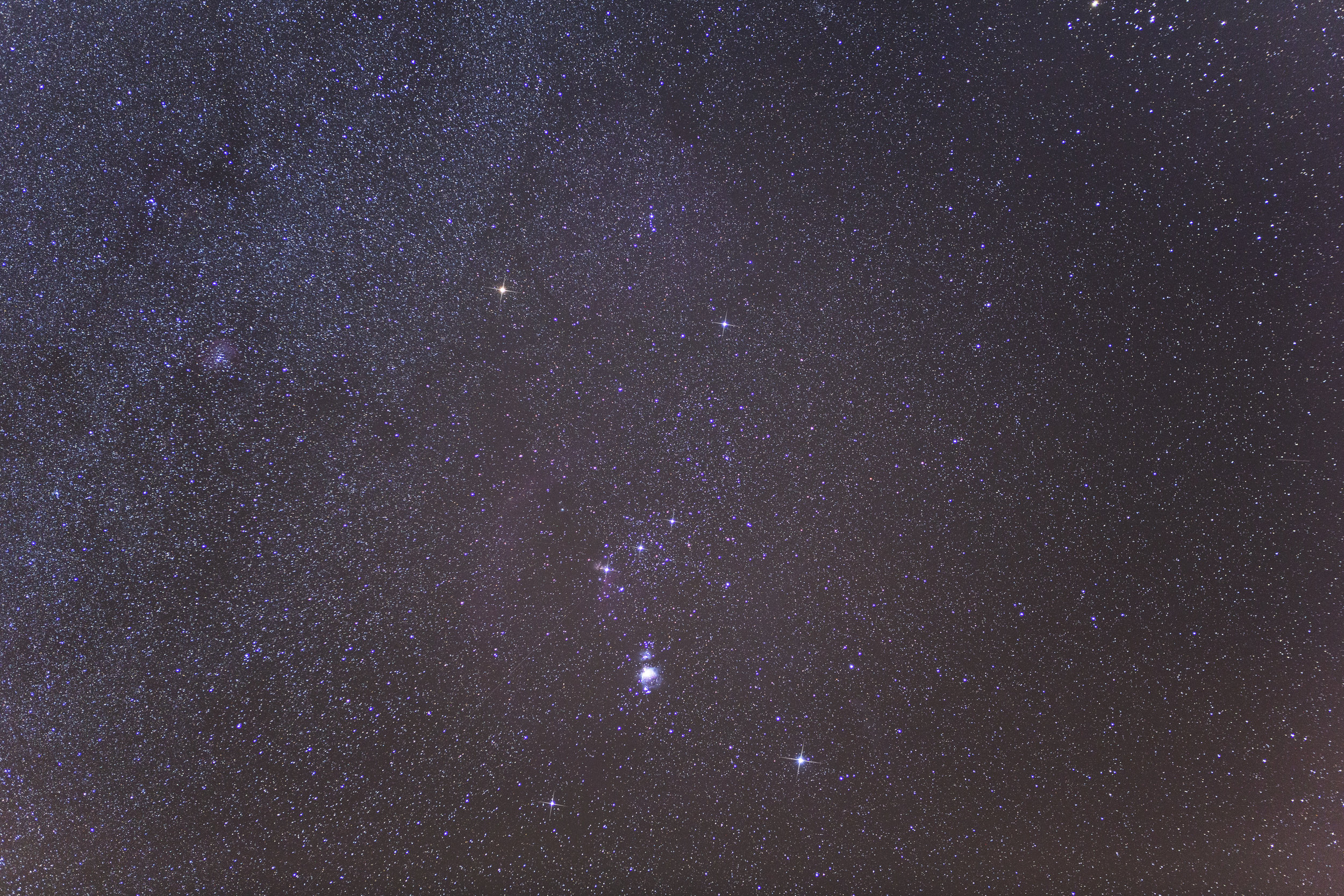
My final capture of the night, was a wider angle exposure of the constellation of Orion. At this point, with dawn quickly approaching, I was rushing to bag this exposure. I wanted to test the quality of my 24-70mm for astrophotography, as it wasn’t a lens I’ve used outside my wedding work before. It was a tracked exposure and productive unbelievable detail in the stars captured through the area.

ISO 800/46mm/f2.8/230secs

ISO 800/46mm/f2.8/230secs

In summary, was the shoot worth while? For me, I would say it was. It was great to capture a Durdle Door with the winter sky, which I feel, would be a good addition to my portfolio. As a learning curve, the shoot was very informative too. I feel much more confident in using the tracker with longer focal length lenses, and it was useful to see the added detail that could be captured using it.

So what next? The moon has now taken over, but a new window of dark skies opens on Saturday night. I will probably try a Milky Way capture, somewhere local, before it finally disappears for the winter!